
Kauai VINELink Custody Coverage
Hawaii Statewide Automated Victim Information and Notification, known as SAVIN, is delivered through VINELink. DCR describes it as a round-the-clock custody information and notification service fed by participating Hawaii correctional agencies. DCR's own inmate-locator guidance points people to this service. That makes VINELink relevant to KCCC detainees and Hawaii state prisoners whose data is represented in the participating feed.
Coverage has limits. KPD's short-term cellblock report is a separate police-stage source. Federal prisoners belong in the Bureau of Prisons locator, while a person in immigration custody belongs in ICE's locator. A VINE event can report release, transfer, parole, escape, death, or another custody change depending on the feed. Those labels do not mean the same thing. In particular, transfer from KCCC is not community release, and parole is not final discharge from sentence.
Search One Kauai Inmate on VINELink
Use the live Hawaii interface because fields and prompts can change. Begin with enough known facts to avoid mixing people who share a name. A match should be checked against any displayed identifier, age or birth year, facility, and event detail. Do not rely on a name alone.
- Open the Hawaii VINELink portal and confirm Hawaii is selected.
- Choose the person or custody search shown by the live interface.
- Enter the exact first and last name or an identification number accepted by the form.
- Use only the lawful filters shown, then compare all possible matches with known details.
- Open the matching record and copy the custody status, location, event label, and event date exactly as displayed.
- If the result reports release, corroborate it with KCCC or DCR and the related Fifth Circuit case when the exact legal or physical status matters.
If several matches remain, narrow by a reliable identifier instead of choosing the first result. The broader Kauai County released inmate search path explains how to move from a KPD arrest report to VINE, eCourt, and the correct records custodian.
The official Hawaii SAVIN search page shows the current entry point and search controls.
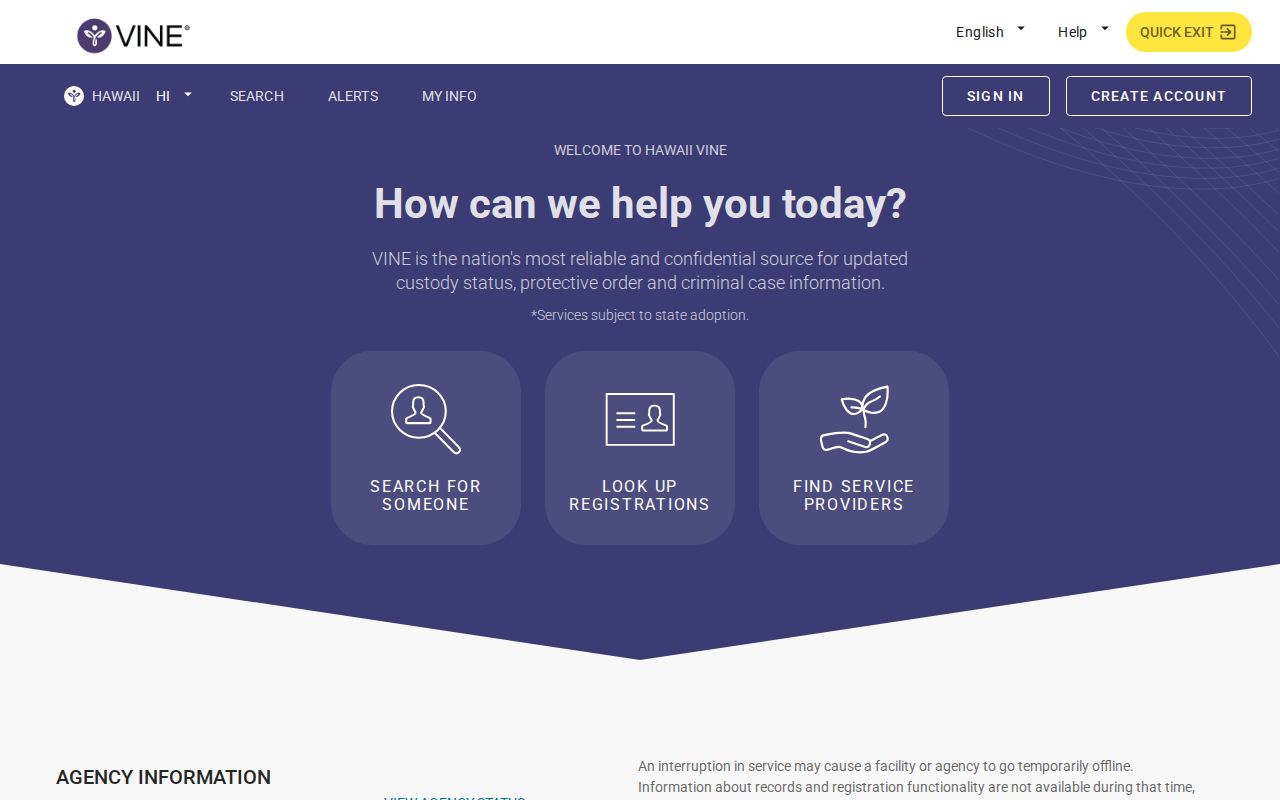
This screen is a live lookup gateway, not proof that every old release remains searchable.
Kauai VINELink Release Fields
The exact fields depend on the contributing record and current interface. Research supports describing name or identifier, age or birth year, custody status, location, and custody-event information only when the live result displays them. No separate Hawaii DCR public profile with a verified projected or tentative release field was found. Never import a field from another state.
| Field | How to read it |
|---|---|
| Name or identifier | Helps distinguish the intended person from a namesake. |
| Age or birth year | A comparison point, not a unique match by itself. |
| Custody status | The participating agency's reported status at the time shown. |
| Facility or location | The reported custody site or status location, not necessarily the place of arrest. |
| Event type and date | The event label and time supplied by the feed. Preserve the exact wording. |
“Released” may confirm a contributing agency's custody event, but not final sentence discharge or freedom from every agency. A state prisoner paroled by HPA can be outside prison and still under correctional authority. A KCCC detainee may instead leave on bail, recognizance, supervised release, or sentence expiration.
Register for Kauai Release Alerts
Registration begins from the correct person's record. The live portal controls which event types and delivery methods are offered. Phone, email, or text may be available, but a user should not assume every channel appears for every record. Alerts may follow the operational event, so they cannot promise an exact pickup time or exit place.
- Open and verify the correct person and custody record.
- Select the notification or registration option shown on that record.
- Choose from the offered custody events, such as release or transfer.
- Select a live delivery method and enter the destination carefully.
- Complete the displayed confirmation. A telephone flow may ask for a four-digit PIN; email or text may use a link or code.
- Save the confirmation and keep the PIN or account detail private.
- Update the registration if the phone number or email address changes.
A phone PIN confirms receipt and helps protect the registration. Follow the current prompt rather than a saved set of old instructions. Vendor screens can change even though the basic purpose remains the same.
Confirm Kauai VINELink Release Events
A VINE alert is a lead, not the archival release record. Save the event label and time received, then compare it with the custody agency and court record. For KCCC, call the published facility line at (808) 241-3050 for routing or send DCR a focused UIPA request seeking admission, movement, physical release date and time, and destination category. Staff may protect private facts, so a formal request is often the durable path.
For a police arrest episode, use KPD's dated Media Arrest Report and its Release Disposition. For legal authority, check eCourt Kokua. For parole, use the HPA record. BOP and ICE have their own federal systems, and a missing result there does not establish community release.
No Kauai VINELink Match
A zero-result search does not prove release. Try reasonable spelling variants, confirm the state, and use a known identification number if the portal accepts it. The event may be too recent, too old, confidential, KPD-only, federal, immigration-related, or held by another agency. A person can also disappear from a live locator after the source no longer represents the record.
Next, search the related Fifth Circuit case and contact KCCC or DCR for the underlying event. If a KPD report shows ISC, TOT, or a court code, follow the handoff to DCR, court, or the receiving agency. Do not keep searching later KPD reports as though they form a continuous custody history.
Hawaii Locator and Alert System
Hawaii's distinctive setup combines locator and victim-notification functions. DCR's FAQ routes inmate-location questions to SAVIN/VINE instead of offering a separate historical offender and discharge database. The convenience is real: one portal can support a current custody check and an alert registration. The tradeoff is that a vanished result is not a discharge record.
When long-term proof matters, request the DCR record and check the sentencing court. Distinguish physical release from KCCC, release to parole, and final discharge. This Section 19 angle is central to any Kauai VINELink release check because it explains both why VINE is useful and why it must be corroborated.
Kauai Release Verification Chain
Kauai custody can pass through several systems. A KPD daily report describes the police-arrest episode and may show release after bail, no charge, prosecution declined, pending investigation, or own recognizance. It may instead show court, Intake Service Center, KCCC, or other-agency transfer. Once that handoff occurs, VINE and DCR become more relevant to custody, while the Fifth Circuit docket explains the legal order.
For a KCCC record, direct a focused public-record request to DCR rather than to Kauai County. Ask for existing records sufficient to show admission, movement, physical release, destination category, and discharge status during a defined date range. Include a full name, identifier, facility, and known case or booking number. Ask for electronic copies and a cost estimate. DCR may redact protected material under Hawaii's UIPA, so the request should seek segregable public portions rather than assume every detail can be released.
If two records disagree, give the custody agency's event record the most weight for actual physical release and the court or HPA record the most weight for legal authority. Preserve both versions and ask the record holder to explain or correct the conflict. This method is stronger than translating a delayed alert or an empty result into a claim the source does not make.
Beyond Kauai VINELink Coverage
VINELink is not the federal Bureau of Prisons locator. For a federal sentence, search BOP by register number or by name and identifying details. A BOP result marked released means the person has left BOP custody, but another justice authority or federal supervision may still apply. A federal defendant held under U.S. Marshals authority may not yet have a normal BOP sentence record.
ICE's Online Detainee Locator is also separate. It is aimed at current or recently represented immigration custody and is not a full release archive. No official ICE detention center was identified on Kauai. A KPD transfer code alone does not prove ICE received the person. Use the receiving agency record before naming the destination.