
Kauai 72 Hour Release Limits
No official combined 72-hour release list was found for Kauai Community Correctional Center or the Kauai Police Department cellblock. KPD instead publishes Media Arrest Reports for separate calendar-day arrest periods. Reading three consecutive reports creates a three-day arrest view. It does not create a true list of all releases that happened during those hours.
The gap works in both directions. A person arrested on the first day may leave custody after that day’s report ran. A KCCC release during the same period may stem from an older arrest and never appear in the three selected police PDFs. People who entered through another agency may also be absent. Use the wider view to locate likely records, not to count everyone released.
Check Kauai Three-Day Releases
A structured check preserves the date boundaries and makes later verification easier.
- Open the KPD Arrest Log.
- Select three consecutive Media Arrest Reports covering the possible arrest dates.
- Search each PDF for the full name and compare age, residence city, and arrest facts.
- Record the arrest date, release disposition, covered interval, and report run time from each match.
- Read the legend. Separate police-stage release codes from court, intake, KCCC, and other-agency handoffs.
- For a handoff or uncertain status, continue to Hawaii SAVIN/VINE, the Fifth Circuit docket, or the responsible records office.
The Released Last 24 Hours page is better for a focused same-day arrest check. Use the Kauai released-inmate search when the custody path or arrest date is unknown.
Kauai PDFs Are Not Rolling
Kauai’s date-based format is a distinctive local feature. The reports cover arrests from midnight to midnight rather than a live “past 72 hours” clock. Observed filenames include a morning generation time, but KPD gives no guaranteed posting schedule. A report can therefore preserve an earlier status even when the person’s custody later changes.
The online archive displays multiple dated files, yet no fixed retention period is published. Save the report date and source link when documenting a match. Do not promise that the same archive depth will remain available. If an older report disappears, request the underlying police record by report number, incident date, and record type.
Kauai 72 Hour Report Fields
Each daily report uses the same core fields. Combined carefully, they support identity matching and a police-stage timeline.
| Field | How to use it |
|---|---|
| Name and residence city | Match the person while guarding against similar names. |
| Arrest date and time | Place the arrest in one daily interval. |
| Age and sex | Use as added identity checks. |
| Charge | Identify the reported arrest basis without treating it as a conviction. |
| Release disposition | Read the KPD outcome or destination code. |
| Run time and covered interval | Measure how stale the status might be. |
Missing fields matter. The sampled format has no photo, booking number, exact release timestamp, or KCCC housing field. It does not identify every later movement. Three daily reports do not fill those gaps.
Kauai Weekend Release Checks
A three-day review is useful after a weekend because it collects several arrest dates in one pass. It should not be described as a special weekend-release roster. Research found no KCCC rule promising routine exit times, early Friday release, or a public pickup point. Holidays, court processing, bail posting, and other holds can affect the actual event, but no local schedule should be invented.
Families planning transportation should call KCCC before traveling and follow facility directions. Do not wait on secure grounds without approval. For a court-based release, read the docket for the order and then confirm the physical event with the custodian. A release order may precede bail posting or remain subject to another hold.
Open Kauai Arrest Report Dates
The official KPD report archive is the correct source for selecting three consecutive arrest dates.
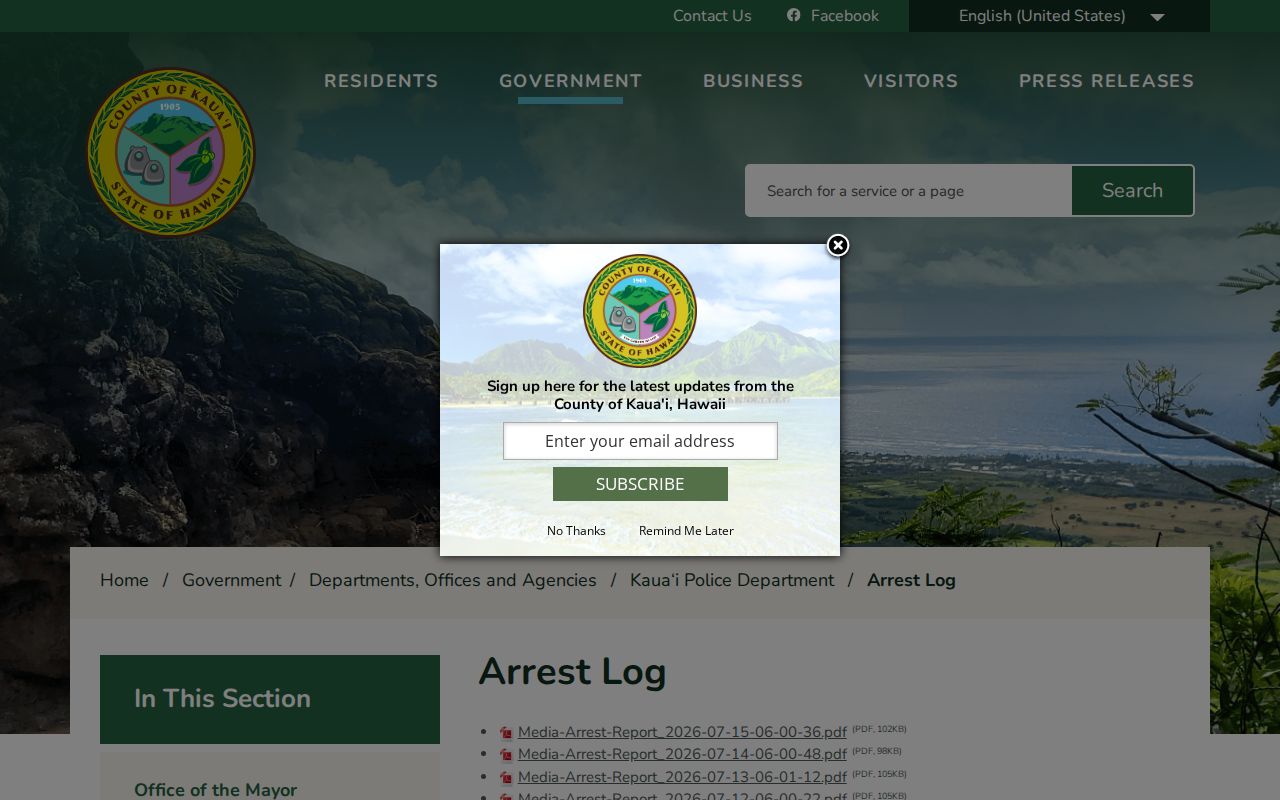
Use the page’s disposition legend with every selected report. A plain text search can locate a name, but the full row and report timestamp supply the needed context.
Classify Kauai Release Dispositions
KPD release codes include RBL for bail or bond, ROR for own recognizance, RNC for no charge, RPC where prosecution declined, and RPI for release pending investigation. These describe release from the police episode. The Fifth Circuit case can show later conditions or disposition.
By contrast, DCT, CCT, and FCT identify court destinations. ISC points toward intake or KCCC, and TOT indicates transfer to another agency. None alone proves community release. “Not Released” is also time-bound to report generation and can become stale.
Verify Kauai KCCC Releases
For KCCC, search Hawaii SAVIN/VINE. DCR routes locator questions there instead of maintaining a separate public historical offender database. VINE can report custody changes and offer notifications, but its results may lag. No match does not establish a release or final discharge.
Use eCourt Kokua for the related Fifth Circuit case. Bail, recognizance, dismissal, time served, and supervised-release orders can explain legal authority. They do not by themselves prove the physical exit. If exact admission, movement, release time, or destination is required, send DCR a focused request using the Hawaii OIP form. Ask for existing records sufficient to show those fields during a named date range.
KPD’s separate Records Section handles police arrest and cellblock material. Include the report number, incident date, and requester details. KPD advises allowing time for confidentiality review. Use its current page for live counter hours because temporary schedules should not be treated as permanent.
Kauai Custody Systems Differ
KPD holds people briefly and reports the immediate arrest-stage outcome. KCCC is the state-run local jail with both pretrial and transitional roles. A Kauai case can also move to another state prison, federal custody, or another agency. The correct source follows the custodian, not merely the county where the case began.
If sources conflict, use the physical custodian for the actual release event and the court for legal authority. Preserve each source’s terms. Released, paroled, discharged, transferred, and turned over do not mean the same thing.
Build a Kauai Release Timeline
Start the timeline with the arrest event, not an assumed release. For each selected PDF, record its covered period and generation time. Add the KPD disposition exactly as printed. If that disposition is a handoff, add the receiving system as a new step. The Fifth Circuit docket can then supply the date of a bail, recognizance, dismissal, or sentencing order, while DCR holds the physical KCCC movement.
Keep legal and operational milestones separate. An order may authorize release before processing is complete. A VINE alert may arrive after the change. Parole release starts supervision and is not the same as final discharge from the sentence. This event-by-event method is more reliable than assigning all three days’ names to one release bucket.
Request Kauai Three-Day Records
An agency does not have to create a custom 72-hour compilation merely because a requester asks for one. Request the records that already exist. For KPD, identify each report date, incident number if known, and the disposition material sought. For DCR, ask for records sufficient to show admission, movement, physical release date and time, and release or destination category for the named person and date range.
Include aliases and a case or booking identifier when available. Ask for electronic copies and an estimate before fees pass a chosen limit. Hawaii’s OIP process permits search, review, segregation, and copying charges under its rules, while court document prices follow a separate schedule. A broad request sent to the wrong custodian can slow the answer without expanding access.
Public Record Search
Sponsored Results