
Kauai 24 Hour Release Limits
Kauai has no verified rolling list of people released from Kauai Community Correctional Center during the past 24 hours. KCCC is operated by the Hawaii Department of Corrections and Rehabilitation, not by a county sheriff. DCR does not publish a KCCC recent-release tab or a public historical discharge profile. The official local online source that comes closest is the Kauai Police Department Media Arrest Report. It covers arrests for one calendar date and records the police-stage release disposition when the report is generated.
That difference is crucial. The KPD report is not a release-event ledger. Someone arrested during its covered day may be released after the report runs. Another person may leave KCCC that day even though the arrest began earlier or with another agency. A “Not Released” entry is only a snapshot. Likewise, a KPD handoff code does not mean the person entered the community.
Check Kauai Same-Day Releases
The fastest route depends on where the person was held. Follow the record trail instead of looking for one countywide roster.
- Open the official KPD Arrest Log and choose the PDF for the arrest date.
- Match the full name and other listed facts. Similar names can refer to different people.
- Read the Release Disposition and the report legend. Do not rely on the charge column to infer custody.
- If the entry shows court, intake, KCCC, or another agency, continue with Hawaii SAVIN/VINE and the Fifth Circuit case.
- If a definitive physical release time is needed, request the existing disposition or movement record from the agency that held the person.
For a named person whose arrest date is uncertain, begin with the broader pathways on the Kauai County released-inmate search. The Released Last 72 Hours guide explains how to compare several daily reports without mislabeling them as a true release list.
Kauai Release Codes Explained
KPD’s explicit codes make its report more useful than a bare released/not-released label. They describe what happened at the police detention stage. RBL means released on bail or bond. ROR means released on the person’s own recognizance. RNC indicates release with no charge, RPC means prosecution declined, and RPI means released pending investigation. These codes support release from that police episode, but the court docket is the stronger source for later conditions and case disposition.
Other codes describe movement, not freedom. DCT, CCT, and FCT point to District, Circuit, or Family Court. ISC points toward the intake/KCCC path. TOT means turned over to another agency. A person can leave the KPD cellblock yet remain in legal custody. Follow the destination before calling the event a community release.
Kauai 24 Hour Report Fields
The sampled Media Arrest Report provides enough detail to identify an arrest event and interpret its immediate outcome, but it omits several fields people expect from a jail-release feed.
| Field | What it establishes |
|---|---|
| Name and residence city | Identity clues that still require careful matching. |
| Arrest date and time | When the reported arrest began, not the release time. |
| Sex and age | Additional matching details in the sampled format. |
| Charge | The reported basis for arrest, not a finding of guilt. |
| Release disposition | The KPD-stage outcome or next custody destination. |
| Report run time and interval | The limits of that report snapshot. |
The report does not supply a booking photograph, booking number, exact release time, or KCCC housing field. Its arrest date cannot safely be substituted for a release date.
View Kauai Daily Arrest Reports
The official KPD Arrest Log page lists the dated Media Arrest Reports and provides the key needed to read their dispositions.
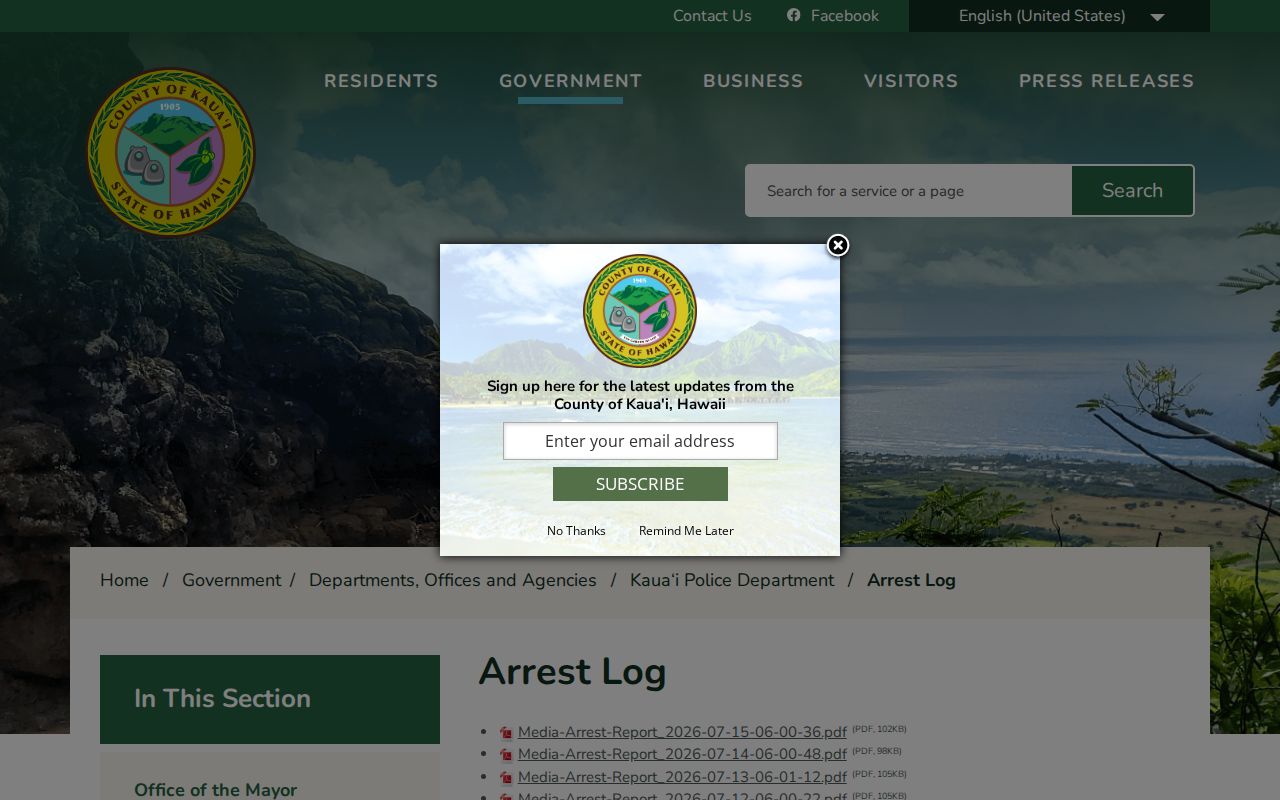
Choose the report by arrest date, then note when it ran. The archive shows multiple dated PDFs, but KPD publishes no fixed retention term or guaranteed update schedule for this online set.
Confirm a Kauai Release Record
If the KPD entry is missing, stale, or points onward, check Hawaii SAVIN/VINE for a current custody change. DCR directs inmate-locator questions to that system. VINE can send custody notifications, but an alert can lag and should not be used as a promise of an exact exit time. A missing result is not proof of release.
The related Fifth Circuit docket can show bail, recognizance, dismissal, time served, supervised release, or another legal basis. Court authority and physical release are distinct. Posting bail may occur after an order, and another hold can keep a person in custody. For KPD records, use the KPD Records Section. For KCCC admission, movement, and release material, submit Hawaii’s OIP form to DCR.
A focused request can ask for records sufficient to show the named person’s admission, facility movements, physical release date and time, release category or destination, and final discharge status for a stated period. Include identifiers and ask for an itemized estimate before chargeable work. Agencies may redact protected details under Hawaii’s Uniform Information Practices Act.
Kauai Release Versus Transfer
A police-stage release code, a VINE custody change, and a court order answer different questions. The KPD code can show departure from the cellblock. DCR holds the KCCC movement record. The Judiciary supplies the legal order. When exact status matters, compare them and give the physical custodian’s event time the most weight.
KCCC itself serves both pretrial or short-term people and sentenced people nearing community return. Its mixed role means a local case can move through police, court, intake, and state corrections systems. A live roster disappearance may reflect release, transfer, a spelling issue, or a data delay. Confirm the destination rather than treating absence as proof.
Kauai Same-Day Release Timing
The report’s arrest time and generation time should never be recast as the time someone walked out. KPD publishes no exact release-time field in the sampled PDF. DCR also does not publish routine KCCC exit hours, a public pickup location, or a same-day release schedule. Those facts must come from the custody record or current facility direction.
Timing can change as bail is posted, paperwork reaches the custodian, court action is entered, or another agency hold is checked. “Own recognizance” means release without posting money on that case, but it can include conditions and does not cancel an unrelated hold. “Time served” concerns how a sentence is credited; it is not an online timestamp. If transportation depends on the event, call the responsible facility before travel and do not wait on secure grounds without instructions.
When Kauai Releases Appear Later
A later custody change does not make the earlier KPD report false. It means the report captured the status at its stated run time. Preserve both dates when building a timeline. If the person was marked Not Released and later leaves KCCC, the DCR movement record should establish the later physical event.
VINE registration is most useful before an expected change. Select the matching Hawaii record and follow the live notification prompts. Available phone, text, or email options can change. Save the confirmation and keep registration credentials private. After an alert, verify the release category when the difference between community release, parole, and transfer matters.
Public Record Search
Sponsored Results