
KPD Detention Release Records
The Kauai Police Department Detention Center is KPD’s short-duration holding and central-booking setting. The department’s official annual report describes two holding cells, six detention cells, a booking and processing area, and a control center. Current KPD releases still use the term “KPD cellblock.” These facts describe a police detention function, not a county sheriff jail and not the state-operated Kauai Community Correctional Center.
That distinction controls the search. KPD documents the immediate police-stage outcome. If a person enters KCCC, the record trail shifts to the Hawaii Department of Corrections and Rehabilitation, or DCR. If the person goes to court, the Fifth Circuit docket becomes important. A later release from KCCC cannot be proved solely by the earlier KPD report.
Where KPD Releases Go
The Daily Media Arrest Report provides the local path. Some codes document release from the police episode: RBL for bail or bond, RNC for no charge, RPC when prosecution was declined, RPI for release pending investigation, and ROR for own recognizance. Those entries support a community release from KPD custody, though another case or agency hold could still matter.
Other entries show continued movement. ISC points to the Intake Service Center. TOT means the person was turned over to another agency. DC, CC, and FC identify movement to District, Circuit, or Family Court. “Not Released” states only that the report did not show a release when it was generated. It can become stale after later bail, court action, or transfer.
| Report result | Next verification step |
|---|---|
| RBL, RNC, RPC, RPI, ROR | Confirm the report identity and request the exact event record if time or conditions matter. |
| ISC or KCCC path | Use Hawaii VINE, DCR records, and the related court case. |
| DC, CC, or FC | Read the Fifth Circuit docket and then confirm the physical custody event. |
| TOT | Identify the receiving agency before describing the person as free. |
| Not Released | Check later custody, court, or agency records. |
Search KPD Detention Releases
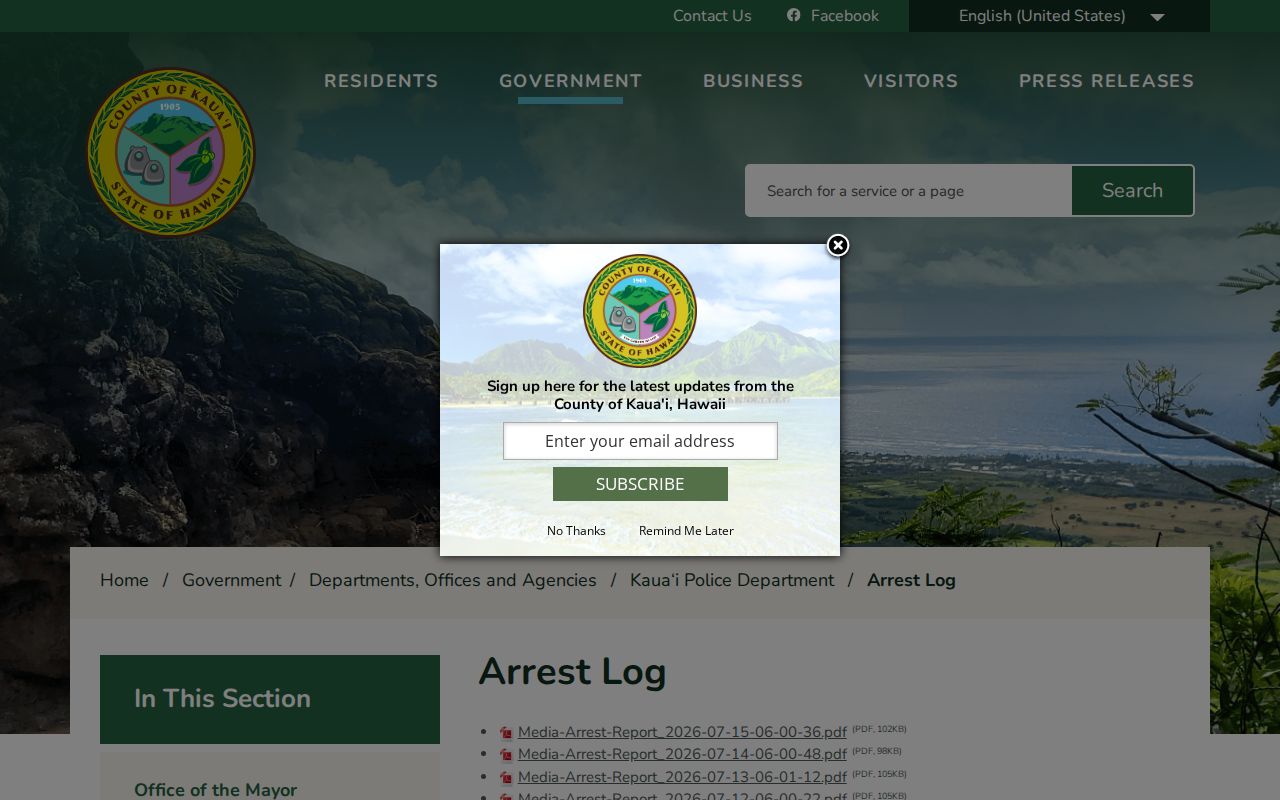
KPD does not publish a live cellblock roster, booking-photo gallery, or mobile jail application. Its official Arrest Log page links calendar-day Media Arrest Report PDFs. Each report covers arrests and dispositions known at generation time. It is not a continuous inmate file or a list limited to released people.
- Open the KPD Arrest Log and choose the report for the arrest date.
- Match the full name, report number, arrest date, agency, and offense information.
- Read the “Release Disposition” exactly as printed.
- Use the report legend to decode the result.
- If the result shows court, ISC, KCCC, or another agency, continue in that system rather than searching more KPD reports as though they were a roster.
The full Kauai release search and record-request chain is covered on the Kauai County released inmates home page.
KPD Daily Release Report Limits
The sampled report carries a run timestamp, and observed filenames indicate generation around the early morning. KPD does not guarantee a real-time cadence or exact daily posting hour. Corrections, delayed entry, transfers, and new arrests can change the picture after generation. The sampled format does not show an exact release time.
One current PDF can approximate a one-day view, but it remains an arrest report. Comparing three consecutive reports can approximate a three-day review. Neither method creates a verified KCCC 24-hour or 72-hour release list. Where timing or destination matters, ask for the existing event record rather than asking KPD to create a custom release compilation.
The official page shown below gives access to the dated reports and disposition legend.
KPD Detention Records Requests
KPD Records is the durable channel for an arrest, booking, cellblock, or disposition record. Identify the report number and incident date. Include the person’s full name, known alias, and a narrow date range. Ask for existing records sufficient to show booking, release or transfer, event time, and disposition. If the photograph matters, request the booking photograph on a separate line.
The KPD Records Section says most information can be released when Hawaii UIPA requirements are met, often after the investigation is complete or closed. Confidentiality review and redaction can apply. KPD asks requesters to allow 48 hours for an initial response and schedules pickup when a report is ready. That guidance is not a guarantee that every record will be produced within two days.
KPD Records Section
Report status: (808) 241-1929
Email: kpdinsurance@kauai.gov
Hours: Check the live Records Section page before visiting because temporary schedules change.
HRS chapter 92F permits access subject to privacy, law-enforcement, and other exemptions. Ask for nonexempt portions to be segregated. Also request an itemized cost estimate before chargeable work begins.
KPD Booking Photo Records
The daily Media Arrest Report contains no booking photograph in the sampled format. It should not be described as a mugshot feed. A KPD arrest image, if maintained, belongs with the KPD police-record request. A later KCCC intake image belongs to DCR instead. Name the custodial episode so the agency can identify the correct record.
Ask whether a responsive photograph exists and is disclosable. Availability of the text report does not mean every underlying image must be published. Hawaii’s public-record law requires a record-specific analysis, and personal data or investigatory material can be redacted or withheld.
A photograph also cannot establish the later custody outcome. Pair any disclosed image with the report number and disposition record, then check the next agency when the code shows a handoff. If an arrest record is later expunged or a court file is sealed, follow the current official source rather than relying on an old copy.
KPD Transfer Record Checks
A court code should be followed in eCourt Kokua. Read the docket chronologically for bail, recognizance, dismissal, remand, sentence, or another order. An order can explain legal authority, but it may precede the physical move. KPD or the next custodian confirms the event itself.
For ISC or KCCC, search Hawaii VINE by exact name or identifier and verify the result. No match is not proof of release. If another-agency transfer is shown, identify that custodian first. A TOT entry alone does not establish federal or immigration custody.
Federal and immigration paths require their own tools. The Bureau of Prisons locator does not cover routine KPD detention. ICE’s locator is not a full release archive, and no official ICE detention facility on Kauai was identified. Use those systems only when a person-specific record supports that route. If the receiving agency remains unclear, request the transfer or disposition record from KPD and ask for the destination category that can lawfully be disclosed.