
Kauai Parole and Probation Compared
Parole follows a prison term and is administered by the Hawaii Paroling Authority, or HPA. It permits a person to live outside secure confinement while still under correctional authority and stated conditions. Probation is a sentence imposed by a court and administered on Kauai by the Hawaii State Judiciary's Fifth Circuit. A probationer may never have served a prison term. Both statuses can involve rules, reporting, and court or agency action after a violation, but the legal source and supervising office are not the same.
A third track matters on Kauai. The Kauai Intake Service Center may supervise a defendant before trial or before final sentencing after a court orders release from secure custody. That person may not have been convicted. Calling this status probation or parole can lead to the wrong office and a false account of the case.
| Status | Authority | Best public confirmation |
|---|---|---|
| Parole | HPA and DCR Parole Services | HPA action, DCR record, and related Fifth Circuit docket |
| Probation | Hawaii Judiciary, Fifth Circuit | Judgment, sentence, and later probation entries in eCourt Kokua |
| Pretrial supervision | Court and Kauai Intake Service Center | Release order and current court docket |
Verify Kauai Post-Release Supervision
No verified statewide public name search covers ordinary parolees and probationers. Start with the legal record rather than guessing from a person's location or from a missing custody result. eCourt Kokua is the main public route for Kauai criminal cases. Confirm the party, case number, Fifth Circuit court, judgment, sentence, release order, and any later modification or revocation. Basic case information is free, while linked documents may carry the Judiciary's current purchase fee.
- Search eCourt Kokua by the full name or known case number and verify that the case belongs to the Fifth Circuit.
- Read the docket in date order. Look for a release order, judgment, probation term, mittimus, parole-related filing, violation, revocation, or discharge entry.
- If the judgment imposes probation, use the Fifth Circuit directory to reach Adult Client Probation Services.
- If the record involves an indeterminate prison sentence or parole action, check the Hawaii Paroling Authority materials and request the final public action that can be disclosed.
- If release occurred before trial or sentence, confirm the court order and contact the Kauai Intake Service Center only for that supervision track.
- Ask only for public status confirmation or proper message routing. Do not seek a private address, schedule, or sensitive reporting detail.
A VINE result can help show a custody event reported through DCR, but it is not a full supervision file. A parole entry also does not prove final discharge. Use the court or HPA record to establish the legal status and the custody agency record to establish the physical release.
Kauai Supervision Office Routes
Kauai uses separate state and judicial routes. The current Fifth Circuit directory controls probation contacts because office details can change. Its combined Adult Client Probation Services office handles Circuit, Family, and District probation, along with deferrals and presentence work. Kauai does not have a separate District Court Probation Branch. For parole, HPA and DCR Parole Services are the proper authorities. For pretrial or presentence supervised release, use the Intake Service Center.
Kauai Intake Service Center
3-3100 Kuhio Highway #C-5
Lihue, HI
Phone: (808) 241-3122
Fax: (808) 241-3128
This office handles court-ordered pretrial and presentence supervision, not ordinary probation or parole.
Fifth Circuit Adult Client Probation Services lists (808) 482-2400 in the current Judiciary directory. HPA's main line is (808) 587-1300. A direct call may route a lawful status question, but staff can withhold protected facts. For a durable answer, cite the case number and request the specific filed order, final notice, or existing public record.
The official HPA page is the source for current parole contacts and authority materials.
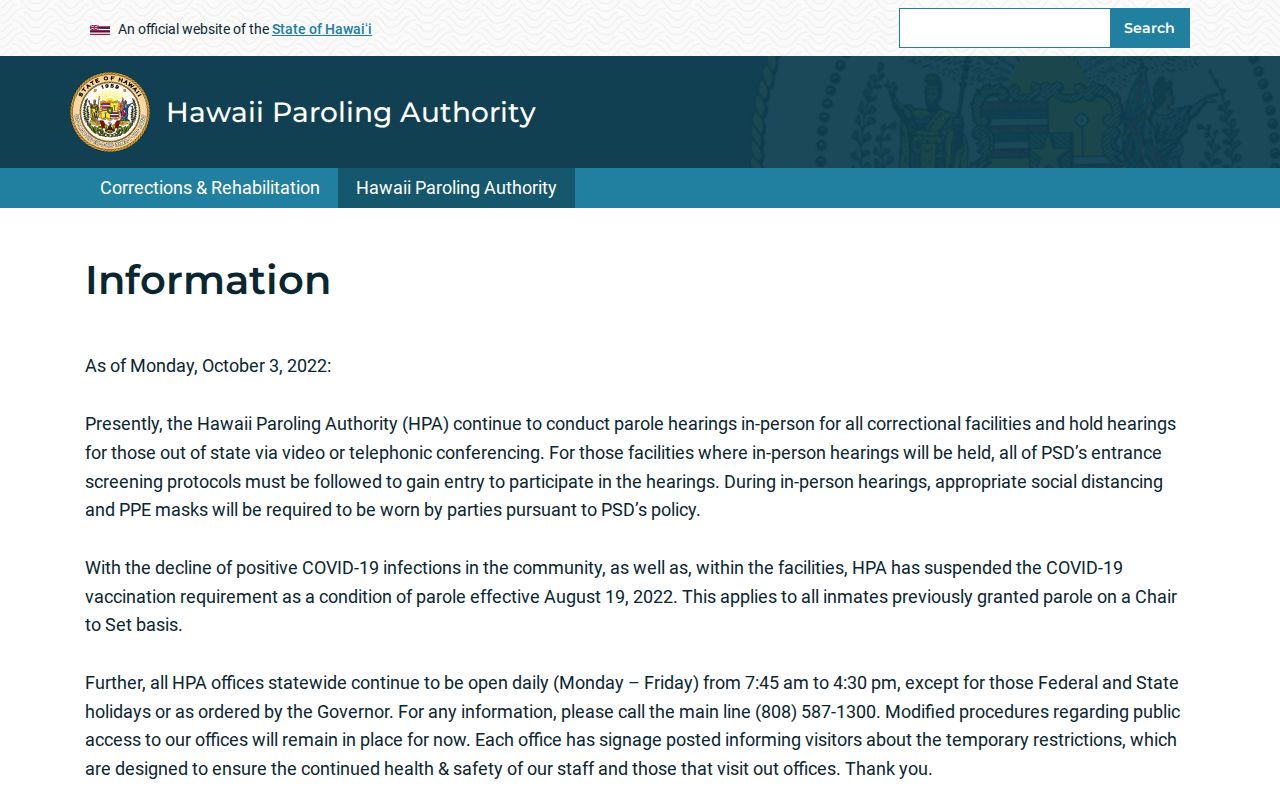
The page confirms that parole questions belong with the state authority, while Kauai probation remains a Fifth Circuit Judiciary matter.
Kauai Warrants and Supervision Claims
Conditions vary with the governing order. They may direct reporting, travel approval, treatment, or compliance with other court terms. Only the actual order and responsible office establish which conditions apply. A claimed violation may lead to a court hearing, an HPA retake or revocation process, or a new case, depending on the supervision type. Those events are not interchangeable.
No official public Kauai parole or probation absconder list was substantiated. A person who does not answer a phone, misses a meeting, or no longer appears in VINE must not be labeled an absconder. Check the Fifth Circuit docket for a bench warrant or violation filing. For parole, seek HPA or DCR confirmation of a retake action. A new criminal warrant belongs to the issuing court or law-enforcement record. Absence from a search is never enough.
Note: A bench warrant, parole-retake warrant, and new criminal warrant arise from different legal records and should be described separately.
How Kauai Supervision Ends
Release from a facility is not the same as discharge from a sentence. A person on parole remains under HPA authority until the controlling term ends or a valid discharge action occurs. Probation ends through the court's sentence and any completion, modification, early termination, or revocation order. Pretrial supervision ends through the criminal case and the court's later order, not through an HPA discharge.
For a completed felony sentence, HRS § 831-5 makes a discharge order, certificate, or instrument filed with the conviction court a useful record. That court-file route can remain available after VINE no longer provides useful history. Search the docket first, then ask the clerk for a specific item by full case number. For parole, ask HPA for the final public notice or order that may be disclosed. DCR can separately provide records sufficient to show physical release and sentence status, subject to Hawaii's public-record limits.
The Kauai County release-record guide explains how to request admission, movement, and release events from the correct custodian. Keep the physical event and legal discharge in separate notes. This prevents a parole date, court order, or vanished locator result from being overstated as final sentence completion.
Kauai Release Transition Programs
DCR describes KCCC as more than a short-term booking site. Its local program inventory includes Lifetime Stand, work furlough, treatment, cultural arts, community worklines, and other transition services. This mixed role reflects Hawaii's state-operated community correctional center model. KCCC may hold a pretrial detainee, a short-term sentenced person, or a transitional felon approaching return to the community.
Participation in a KCCC program does not establish parole, probation, or a fixed release date. Use the program information only to understand the setting. Verify the person's status through the court, HPA, DCR, or the Intake Service Center. The distinction matters because a work-furlough or transition setting can still involve DCR custody, while a person on parole has physically left secure confinement but remains under correctional authority.
Three Kauai Supervision Tracks
Kauai's three-track system is the page's central routing rule. Pretrial supervised release runs through the court and Kauai Intake Service Center. Probation runs through the Judiciary's combined Fifth Circuit office. Parole runs through HPA and DCR Parole Services. The same person can pass through more than one track at different points, but each status must be tied to its own dated order or agency action.
When records conflict, the court or HPA record best explains legal authority, while DCR or KCCC best confirms the physical custody event. Preserve the source's exact terms. “Released,” “paroled,” “transferred,” and “discharged” should never be collapsed into one label.